Powered By Blogger

Monday, February 14, 2011

At The Heart of Good Education

At the end of the day we ask, "In whose image are the students formed?"
          St. Anthony School was in a festive mood early Monday morning, February 07, 2011 preparing for the Thanksgiving Mass for school’s Diamond Jubilee.   The foundation day of SAS was on February 11, Feast of Our Lady of Lourdes is the School's Foundation Day hence around this date were the activities set--musical concerts, rides, booths, streamers on display, academic and art exhibits, motorcade, and family day starting February 04 to 12.
          I was fortunate to attend the Thanksgiving Mass  with the school’s administrators, staff, teachers, students, some parents and various guests which included Sister Marie Fides Pangilinan of the Sisters of St. Paul of Chartres, High School Principal during the time that I was a student of the school.   His Eminence Gaudencio Cardinal Rosales—Archbishop of Manila—was the Main Celebrant for event.  He concelebrated with Msgr. Rolando Dela Cruz, former Director of St. Anthony School and now Director of Paco Catholic School, Rev. Fr. Ed Tiamson, alumnus of St. Anthony School and is current Director of Lourdes School, Rev. Fr. Benny Tuazon, Director of St. Anthony School and Parish Priest of Singalong, and Rev. Fr. Nolan Que, current Assistant School Director in St. Anthony.
          I re-composed below the homily of Cardinal Rosales though not verbatim:
                    We are now gathered in Thanksgiving for the 75th Anniversary of St. Anthony School.  Just to highlight the importance of education, let me share with you this story.

“In those days when empires flourished, two kingdoms fought fiercely in battle. After the war, the winners had a right to amass whatever they could get from the vanquished kingdom.  So most of the victors were getting whatever loot they could—jewelries and other valuables in the home, tools and machines of their trade, farm animals, horses, food stock, etc. 
"Let the little children come to me..."
          The victor king however declared, ‘Give the children to me… The children are mine.’ The wise king started educating the children in honorable living and made them understand the ideals of goodness, kindness, respect, generosity, self-sacrifice and love.  Thus was born a new generation of people in the kingdom.  This generation believed in the power of love and put an end to wars.”
Young people are attracted to the Truth especially when goodness and love accompanies it.
          Parents and teachers are truly important in shaping the lives of our students.  How much we value the legacy of our parents who day in and day out would emphasize to us the value of education.  I remember my parents who would always say to me during meal time, “Son, we are not rich but we give you education. We would not be able to give you much wealth.  Value your education because that is our legacy for you.”  For the alumni of this School like Fr. Ed here, you could also confirm these words from your own experiences. Ed ucation is a legacy. 
          All good things start small.  This school had a humble beginning. It was like the Ermita Catholic School established by the Franciscans a hundred and two years ago.  The Franciscan friars brought Jesus Christ to the people. They came to talk to them about the Truth.  Young people are attracted to the Truth especially when goodness and love accompanies it.  Love welcomes everyone.  Educating people this way, we stop wars.  The king was right…“Give the children to me…”  Didn’t Christ also say “Let the little children come to me…”?
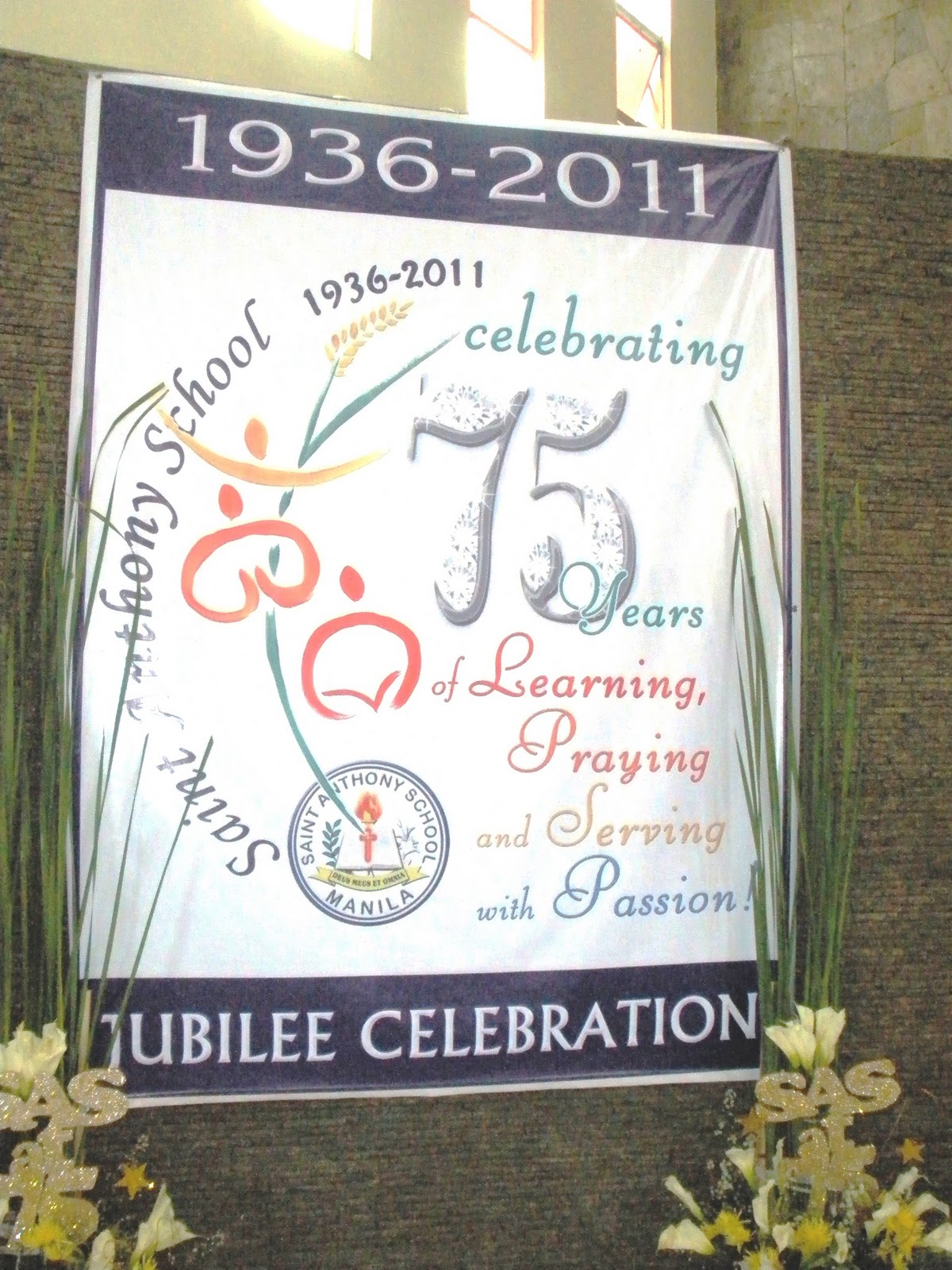
          Do not glory on the 75 years of the School but glory instead on the years of patient dedication offered by many people to make the School possible.  Let us thank God for those who started and sacrificed for the School—the Franciscans, the school administrators and staff, the teachers, the parents, alumni and all students.  Happy 75th Anniversary!
Love becomes the inspiration that promotes real peace and development.
          Reflecting on Cardinal Rosales' homily above, one sees that at the heart of good Catholic education is  the commitment given by its educators—parents, teachers, administrators, and other school personnel—to  communicate Christ and to help form Christ in the lives of the students.  Fidelity to convey the truth about Christ is not an easy job.  It demands a great deal of love—prayer, sacrifice, and work.  Yet their love becomes the inspiration that promotes real peace and development.
Ms. Ofelia Meneses-Principal of SAS, Ms. Amelia Chua-SAS Prefect of Studies, 
Fr. Benny Tuazon-SAS Director, Sr. Fides, SPC-Former HS Prinicpal of SAS, and myself.
          Through the 75 years, thank God for the SAS educators…my great esteem for them!


Saturday, January 29, 2011

It's Project Everlasting


Our neighbor Bambee promised to show me the greeting card she made for her parents’ golden wedding anniversary yet our busy schedule during the holidays did not allow us to see each other. I wanted to use her handmade card as a visual aid for the class on the Sacrament of Matrimony I will be giving to a club of young professional women in our vicinity. Four days before the talk, Bambee sent me not her handcrafted card but a package with a note:  Mel, lending you this book which may be a good reference for the talk you are preparing. Nice Stories! It’s Project everlasting.
Two bachelors and best friends Mathew Boggs and Jason Miller wrote Project everlasting.
 Project everlasting—written by best friends Mathew Boggs and Jason Miller—is a showcase of the greatest marriages in the United States distilled in candid stories to communicate what it takes to make love lasts to more than 40 years.  It documented the highlights of their 200 interviews with couples having more than 40, 50, or 60 years of marriage.  They call these couples Marriage Masters not because they have perfect marriages but because they have superbly mastered themselves —their egos—and made their partnerships work for them and their families.
 Everlasting or endless love—is it realistic or is it just a song? I think that a happy marriage is not limited to nice, happy and funny experiences together nor could it be just focused on establishing wealth.  It is the steadfastness to ride the tide of conflicts and difficulties like weaknesses in character or personality, disappointments, frustrations, poverty, sicknesses, and even death.  It’s taking all the rough with the smooth and with flair of love.
 As the New Year started, I got to know several couples who celebrated their golden years of being together in marriage. Aside from Bambee’s parents, Delsy my co-teacher before at the BCPD School in Cebu City celebrated with spouse Mel their 50th wedding anniversary last December 27.  Then last January 2, our friend Anabelle renewed her wedding vows with husband Walter in celebration of their golden wedding anniversary.  The same is true for the parents of my boss Dr. Glenda who celebrated their 50 years of marriage last January 3.

Fortune Plant keepsake for the 50th Wedding Anniversary Celebration of Spouses Annabelle & Walter Brown.  Like this Fortune Plant, marriage is a gift and a treasure that must be defended, protected and nourished.  With God's blessings, marriage grows hence it truly takes three to marry--husband, wife and God.
Bishop Fulton Sheen said that it takes three to get married—the man, the woman, and God.  Fidelity ensues in a marriage which has been patiently worked out with one’s spouse and with God’s blessings. I know of many tried and difficult marriages that had worked and even failed marriages that became beacons of hope because God was in the relationship.  Faith gave the strength against the odds and solution to whatever may be hopeless.
          Last December 29 was the 46th anniversary of Mama and Daddy’s wedding.  Daddy passed away six years ago so Mama visited his remains in the cemetery of our town in Bauan.  I can attest that their love triumphed even though their marriage was difficult.  The bond between them has been seriously undermined by many challenges but that bond too has always been made stronger by their faith, their children, and their commitment—loving each other to the end.  Their marriage too is Project everlasting.

Sunday, January 16, 2011

New Heights

Lofty goals that connect us with our deeper selves empower us greatly.
          By now, we may be putting into action our new year’s resolutions.  We surely want them  to positively influence us this 2011.   Lofty goals that connect us with our deeper selves—our conscience, our roles and personal mission—empower us greatly.  They make us more free because in doing them them over time, we reach new heights in our courage and confidence, making us more fulfilled, happier.
One needs to calculate his own risks and see objectively if he is fit for the climb.
          Working on lofty goals is like climbing a mountain—it takes enterprise and optimism. Mountain climbing requires great tenacity and lots of work not only in its execution but also in its preparation.  One needs to calculate his own risks and see objectively if he is fit for the climb. It is an advantage if you have a good guide who will help you find the best path and traverse the steep and jagged trails.
I think people who climb love nature including the climb's challenges.
           I had a chance to climb Mt. Batulao with some friends last November.  My friend Carlo made a research about Mt. Batulao--about 1,050 meters above sea level--and persuaded me to go. We started our trek at around eight in the morning. We were like eager beavers at the start but I realized that our climb was also exacting and not just exciting.  It required specific preparation like physical exercises to condition our bodies so that we could muster our energies to reach the top.  I think people who climb love nature including the climb’s challenges.  Carlo found a good guide for us—Jumbo.    
Jumbo said, "When you go to the mountain, it is easier to pray...to talk with God."
          Jumbo does mountain climbing as a hobby but he also offers for a fee his services as guide and organizer of climbs for various groups.  As guide, he knew when and where to give the climbers assistance and support.  He loves mountains and knows a lot of places for nature-tripping that are especially suited for a student’s small budget.  When I asked him why he likes climbing he said, “When you go to the mountain, it is easier to pray ... to talk with God.”  He added that becoming healthy and fit are mere consequences of having frequent climbs.


          There are ten camps before reaching the summit of Mt. Batulao.  We ate our lunch at ten past thirty in the morning at Camp 1.  The camps are landmarks of stones, or simple benches or huts which are similar to World War II refuge stations in the Pacific.  There you can sit for a while to breathe lots of fresh air, to rest and gain more strength and perspective.  We were lucky that there we lots of coconuts so we had thirst-quenching buko juice.  Camp 10 is at the mountain’s summit. 
View from Camp 10 of Mt. Batulao.
An image of Our Lady of Mt. Carmel found on top of Mt. Batulao.
We reached the summit by noon time.
            We reached the top by noon time and there we prayed the Angelus before a statue of Our Lady of Mt. Carmel which, we were told, had been left there by some Salesian seminarists.  We stayed on the cool summit for an hour I think.   Afterwards, Jumbo led us to an easier path for the descent. Byfour in the afternoon, we were on our ride for Manila.
Thanks to our guide Jumbo and escort Ate Mila, we made it to the top.
          On the plus side of it, the climb was a crash course to understand patience, strength, and tenacity to keep on with one’s pursuit.  Concentration and focus is needed so as not to get distracted with what one sees along the way—interesting insects and animals, plants, people and their work, the dark rain clouds, one’s particular fears, or even a very nice panorama.
Reaching new heights initially requires "can do attitude".
          Reaching new heights requires new paradigms or mind-set.  Initially, it requires a realistic “can do” attitude.  One’s goal has to be attuned with reality and be always linked with one’s deeper aspirations and vision, with one’s sense of purpose or mission.  The goal which is to reach the top has to be translated to simple and specific doable steps. One has to be ready to do unusual things like clambering and crawling on all fours—literally like goats—in order to carry out steeper ascent or descent.  Focus and consistency in one’s pursuit are needed to finish the climb.  If not, we fail or we get lost.
In a climb, one has to be ready to do unusual things.
A mountain climb is like a crash course to understand patience, strength, and tenacity to keep on with one's pursuit.
           The sight on the mountain especially at the Batulao summit was breath-taking.  Jumbo was right--then and there, it was easier to talk to God.

Saturday, January 1, 2011

Martha, Martha ... On Women and Home

          A feature in Martha Stewart Living magazine for December 2010 was “A Holiday Brunch At Bedford” where Martha hosted her editors and their families for a morning of food, festivities, and snowball fights in celebration of the magazine’s 20 year-anniversary.  In that event, Martha went all out with her decorating and preparation of Christmas foods with all the special things that made the event very memorable.  She loved to share her visions with as many friends as possible.
          I have admired Martha Stewart in making more attractive and accessible the art and science of homekeeping thus giving the deserved dignity to the work in the home.  Two years ago, the family received as a gift Martha Stewart’s Homekeeping Handbook (The Essential Guide to Caring for Everything in Your Home).  The book was dedicated to all mothers and daughters, fathers and sons who have a room, an apartment, or a home to care for.  A livable and lovely home is always consequence of teamwork.  And this is true even if one lives alone because we need the support of many other people to make our space clean and beautiful, warm and cheerful.  Yet the task of making a house a home corresponds in a special way to women.
         
          A Chinese proverb says “A hundred men can build a house, but only a woman can make a home.” The aptness of women for the work in the home is natural talent.  Pope John Paul II had called this the feminine genius.  One of my favorite accolade said on women came from Saint Josemaria  when he said that “Women are called to bring to the family, to society and to the Church, characteristics which are their own and which they alone can give: their gentle warmth and untiring generosity, their love for detail, their quick-wittedness and intuition, their simple and deep piety, their constancy...A woman’s feminity is genuine only if she is aware of the beauty of this contribution for which there is no substitute—and if she incorporates it into her own life.”
             The other Martha whom I have also thought of was Mary's sister. Martha and Mary are two sisters known in Christian spirituality as icons specifically dedicated to action and contemplation.  When Jesus was received in their home, Martha was taken up in housework while Mary sat by Jesus’ feet to listen to him.   Martha was remembered in that famous refrain of Jesus “Martha, Martha, you worry and fret about many things, and yet few are needed, indeed only one. It is Mary who has chosen the better part; it is not to be taken from her.”  Action or work goes well with contemplation or prayer.
           
          A woman who has good knowledge of the art and science of home and genuine piety is a great fortune and blessing for many—family and society.  If there is so much work, there must certainly be much physical energy needed with regular good boost coming from one's sturdy spiritual life.  The demands of house chores can surely be made compatible with some time—even a quarter on an hour—of solitude so as to be able to gaze at God and pray.  This fusion is the secret of happy homes where smiles are generated and shared with each other.  
An egg artistically painted in Russia with the image of Mary and the Child Jesus.
               Today is the first of January in the year 2011 and is also celebrated by Catholics as a day of Solemnity for Mary, Mother of God.  But I have known her too to be my Mother.  It would be a lovely day to thank Her and our own mothers even in simple ways.  When I was a child, I greatly looked forward to the blooming of gumamelas in our backyard.  I eagerly picked the flower when all its petals had blossomed fully and offer it to Lola Acion, a very old lady and our landlady who lived just at the second floor of the house we rented in Manila for years.  She hardly could see because of her eye cataract but without fail, she would smile at me and would thank me.  Without fail, she would give the gumamela to an image of Mary in her room, would light a candle, and then would tell me stories of favors granted by Mother Mary.  Deep in my heart, I knew my Mother smiled at us.

Friday, December 24, 2010

The Reason of Simbang Gabi


Facade of St. Anthony of Padua Parish Church, Singalong, Manila
               Leaving NCFP yesterday, my office mate Lucille looked forward to waking up early tomorrow for her last Simbang Gabi… very happy to almost completing her nine-day pledge to attend it since December 16.  Many Filipinos showed their felicity for Christmas through the tradition of Simbang Gabi or Evening Mass.  Dawn Masses in preparation for Christmas were celebrated in most Catholic churches from December 16 until December 24.  This would culminate to the joyful celebration of Christ’s birthday with the Misa de Gallo or Midnight Mass on Christmas Eve.
Looking at the church from the side of St. Anthony School

               It is interesting to note that the Simbang Gabi tradition has its roots from Mexico in the 16th century and was adopted in the Philippines during the latter part of the 17th century. Filipino farmers and fishermen were invited to attend the dawn Masses and for practical purposes, it was held at dawn so that they could still work afterwards.  Until now, many would attend the Simbang Gabi.  It is a special way for the Filipino soul to adore and thank their Creator for the ending year, or through it to say sorry, or to ask a concrete favor from God during the Simbang Gabi novena.
Some thirty minutes before 9:00 p.m. December 16, 2010 Holy Mass
               Nowadays, parishes have considered anew the circumstances of the people attending the Simbang Gabi.  Although some parishes would celebrate it either at night or at dawn, our parish -- St. Anthony of Padua in Singalong -- had the Simbang Gabi at 9:00 p.m. and 4:00 a.m.  The congregation in the church would usually await the homily of the priest celebrant so as to enrich more their spiritual preparation for Christmas.  They would also enthusiastically sing the Advent and Christmas songs during Mass.  The church is well lit and is beautifully decorated with local Christmas lanterns called parol.  The main attraction for all inside the Church is the Belen or the Nativity Scene arrangement.
The Joy of Advent is very much in the air during the Simbang Gabi
              During the Simbang Gabi, churches teem with people especially young ones.  I think it is due to the Joy conveyed by the Event as it focused on the Faith and bonding with family and friends.  Filipinos also want to do things together like singing songs and eating good food after Mass.  After each Simbang Gabi, many would anticipate the traditional breakfast options: bibingka or puto bumbong with tsokolate, kape, or salabat. Today, there are more and varied choices for breakfast just outside the church.

               I attended my first Simbang Gabi when I was in junior high school.  My best friend and I decided to attend it so she picked me up at home around 3:30 a.m.  Myra and I then attended the 4:00 a.m. Mass.  After that  Simbang Gabi, we were so sleepy at school the whole day.  I cannot remember now other details of that Mass, but Myra—who has been in the United States for many years—and I would always remember fondly the joy of the experience, our sleepiness, and our breakfast—hot chocolate donuts—after the Simbang Gabi.
Images of St. Joseph with Our Lady expecting the Child Jesus (found just near the entrance of St. Anthony Church)
              The Holy Mass in Simbang Gabi shows the unity of Faith as it transcends the then and now, the here and there.   I know that many Filipinos in the U.S. and other countries also try to have Simbang Gabi even if it’s winter.  Sustaining great traditions truly require genuine devotedness.  Thanks to those who have given their very best, their all, in preserving this Christian tradition and its accompanying Filipino customs.  How they highlight clearly the reason of the Season—the Joy in the coming of Jesus Christ who is yet unborn and defenseless in the Blessed Virgin Mary's womb.  
               
               Maligayang Pasko!

Tuesday, December 14, 2010

The Christmas Cards We Make

We share the Joy of the Season through greeting cards.
          A few weeks ago, I had a get-together with friends on Christmas card-making.  Aside from a good bonding we had, it was also a good chance to unwind.  I remember that one of my holiday chores when I was growing up was to write letters and send Christmas cards to relatives. If receiving a card or a letter gives great joy, what greater joy there is in receiving a handmade card by a friend or by a relative.  However, making cards as gifts may not be applicable for all but it is surely a unique and pleasant way to remember and share the joy of the Season—the advent of the Christ Child.

Aside from a good bonding activitiy with friends, card making is a good rest from the stressful work-days.
          Making handmade Christmas cards would surely demand time and effort but it effectively conveys an important message:  I do care about you and I would like to share this great Joy with you.  It is not the size, nor cost, nor splendor of the card that is most important but the intent and spirit behind giving it.  In these days when many things could be done instantly and when many of us are just very busy, the value of a simple job done carefully in view of the person to whom that job or gift will be offered is even made greater. 
Basic materials: a pair of scissors, white glue, colored paper, card board.  Card magazines could help you get ideas.
          It is easy to start this hobby especially around Christmas time.  The basic materials needed are just a good pair of scissors, white glue, some colored and fine-point sign pens, card board and colored paper, and your imagination.  The whole kit and caboodle can be in a neat or fancy bag or even in a recycled sturdy box.  There you can put another container the various ornamental scraps you can gather from candy wrappers, magazines, old Christmas cards, gift tags, or old calendars, etc.  The possibilities are limitless especially if you know how to improvise creatively and make do with what you have.
Find the object of centerpiece for your card; then cut and paste.
          Once you have your basic materials, you can now explore on how to use them.  One simple way is to cut the paper with precision and paste neatly as attractive centerpiece or subject for your card.  Layer it over another paper to emphasize it further because it serves as its border. Punch art is also interesting and easy.  You can also do an origami (paper-folding) which will be the card’s main motif. Do play with colors to make your card happy and zestful.  The color wheel can guide you at the beginning but do trust your preferences after some time.  A short cut is to ask advice from those who have a good eye for art.  
Behind the Christmas cards we make are the persons we love and care for.
          My Ninang Lootsee is an inspiration for me as regards thoughtfulness and card making.  She has consistently remembered my family and my cousins’ families too—all our birthdays or special events. Her creative works always stun us and receiving a card from her makes us gasp to say “Wow!”   Ninang generously shared with us this craft of making cards.  Though I can never equal her elegance and expertise in this hobby, I keep on at it. I fumble and proceed so awkwardly slow in making my cards yet I try not to lose heart.  Keeping on with the craft is to sustain relationships because behind the Christmas cards we make are the persons we love and care for--to them we impart not only friendship but the gift of ourselves.  This is the greatest art lesson I learned from my Ninang.  Merry Christmas!

Saturday, December 4, 2010

Charisma and Gravitas


John F. Kennedy with wife Jacqueline
                              The credibility of the magnetic personality or one with charisma is not limited to just having good verbal and non-verbal abilities.  The external charm has to be matched with interior substance which is also known as gravitas. Professor Brian Leggett of the University of Navarra’s IESE Business School explained gravitas as a person with dignity, seriousness, dutiful in speech and in conduct, and one who listens well.  Its opposite is levitas or levity which is to make light or fun of serious or important matters.   

               A “Checklist on the Attributes of a Magnetic Personality” by Professor Leggett may look like this:
  •  1. Expert in one field yet possessing good general knowledge 
  •  2. Highly energetic yet controlled
  •  3. Enthusiastic
  •  4. Flexible
  •  5. Has good sense of humor
  •  6. Stands out from the majority
  •  7. Has self-confidence
  •  8. Gets involved with what they are good at
  •  9. Emotionally intelligent
  • 10. Has gravitas
Mahatma Gandhi
      A person with charisma and gravitas has weight of character and depth in personality.   He becomes honorable and admirable because of his zest to communicate without losing the apt and true concern for others.  How does one get gravitas?  Professor Leggett suggested to reflect more deeply on our experiences – professional, social, or personal—and learn from them.  Another tip he gave was to have good listening skills.  “Overcome impatience,” he advised, “because it hinders good listening and thoughtful speaking and objective decision-making.”  He stressed the significance of energy, enthusiasm, and concern for our audience when we share ideas.   
Margaret Thatcher
      Professor Leggett cited that it is very important to learn how to nurture nature. This means cultivating what we already have, especially our knowledge, making it more extensive and intensive.  Working on all these means winning and losing at times or, succeeding and failing.  Examples he gave of known leaders with charisma and gravitas although they differ in personality were John F. Kennedy, Mahatma Gandhi, Margaret Thatcher, and Bill Clinton. 
               
                  I got reminded of Avon’s ‘Charisma’—a perfume launched in the seventies.  It became very popular and was then available in small red roulette bottles and jars.   Using the perfume can make you smell good and surely, can also make you feel good.  Charisma surely attracts but the genuine charisma of a complete man--a person with gravitas--can outlasts his life and will continue to inspire and hold its sway on people beyond his time.