Powered By Blogger

Wednesday, December 12, 2012

Expecting A Baby in a Culture of Truth and Love


Expecting A Baby in a Culture of Truth and Love

The recent good news that Britain’s newest Royal Couple, Prince William and Princess Kate, are expecting their first child—the third in line to be the successor to the Royal throne—gave great joy to many in the United Kingdom and in the world.  The news brought about by the confinement of Duchess of Cambidge in a London hospital due to an acute morning sickness did not escape paparazzi reporters and the official media.  Other trivia or facts on this news were capitalized as sensational for the day, even stories reminiscent of how the late Princess Diana and husband Prince Charles years ago anticipated their first born—Prince William.
Recent knowledge that the Royal Couple--the Duke and Duchess
of Cambridge--is expecting their first baby has been  a great global news. 
The arrival of a baby in a family is normally viewed as a blessing and a cause for joy.   In the Philippines, the parents’ usual understated enthusiasm is also mixed with expected tensions as they prepare for this new  member of the family.  The crib, the little clothes, and the baby’s booties...all these are prepared one by one as much as possible before the baby comes.  The mother takes more than the usual precaution of herself while the father works harder to save more to cover the needs of his spouse and the soon-to-be-born daughter or son.  Once the bundle of joy arrives, everyone at home suddenly acquires light, color, and life.  The baby now becomes a center of attraction and the family members are entertained and awed with the little one’s growth and development.

Each life from the moment of conception
in the mother's womb is sacred,
Amid various perceptions on each child that is to be born, I sigh with relief when a child’s life is safeguarded by both the baby's mother and father.  Is it not at this point where we should really secure the future of a human being’s quality of life?  Is it not here when we protect the sacredness of the person and endeavor to thwart the various threats to the survival of the greatest value on earth?  Definitely, the world welcomes a V.I.P.’s especially if the one to be born has good social and economic standing.  If one is not a prince but only a “commoner” or “indigent” in  society—another mouth to feed they say—many frown.  The poor or weaklings, they say, should not be so many because they will frustrate the ideal of a great, intelligent, and progressive society.  And the birth of many poor ones unsettles and disconcerts even those who benefit from the families of these children.  And if it is in their power, they will even legislate laws or ordinances to control births with this in mind--an apparent quality of life.

May they be allowed to celebrate their birthdays and their first "Christmas" as well.
On the other side of the issue, a new life that begins from the moment of conception means news of good tidings.  Protection of that fetus, the baby-in-potency starts for the parents. And for a parent’s caring and loving heart—for that father or  mother, especially for the mother who bears and gives birth to a new life—that child will always be a treasure, her Prince or her Princess, no matter what.  In these days of Advent, may we also thing of the children to be born whose lives just started to be formed… May they be allowed to have birthdays and celebrate their first “Christmas” too.

The Virgin of Guadalupe is known to be the Protector of the Unborn.  Know also the beautiful story of the Virgin of Guadalupe from this link: http://www.catholic.org/about/guadalupe.php

John Paul II wrote one of the best prayer in promotion of a culture of life with Our Lady of Guadalupe as inspiration:


O Mary, bright dawn of the new world,
Mother of the living,
to you do we entrust the cause of life
Look down, O Mother, upon the vast numbers
of babies not allowed to be born,
of the poor whose lives are made difficult,
of men and women who are victims of brutal violence,
Of the elderly and the sick killed by indifference or
out of  misguided mercy.
Grant that all who believe in your Son
may proclaim the Gospel of life with honesty and love
to the people of our time.
Obtain for them the grace to accept that Gospel as a gift ever new, the joy of celebrating it with gratitude
throughout their lives and the courage to bear witness to it resolutely,
in order to build, together with all people of good will, the civilization of truth and love, to the praise and glory of God, 
the Creator and lover of life.

Blessed Pope John Paul II

Sunday, December 2, 2012

Getting Sick and Getting Well

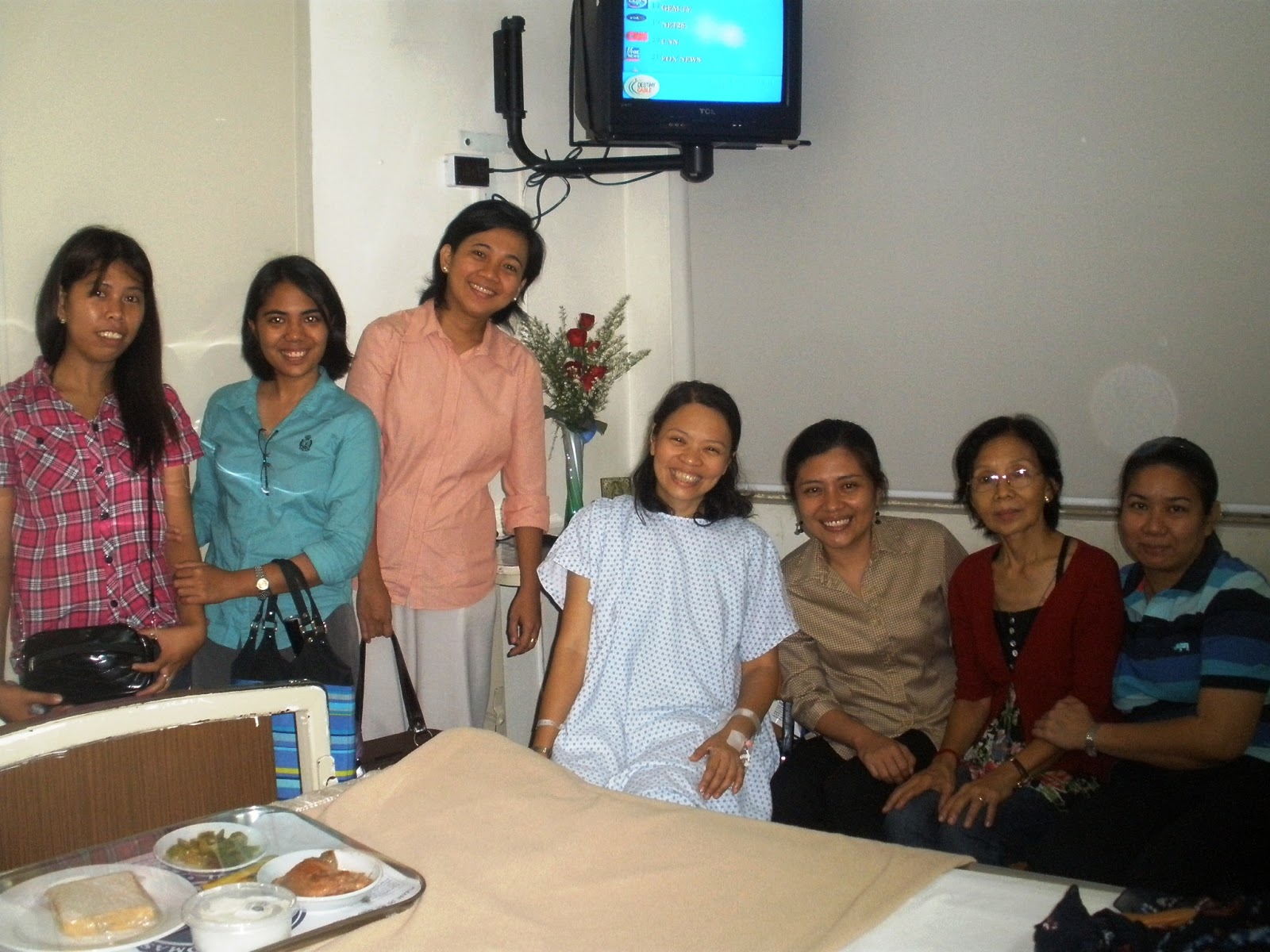
“Getting Sick and Getting Well” is my crash course on time.  Two weeks ago, a sudden painful condition required that I submit myself for surgery.  Much as I have been avoiding this, an emergency operation was seen as the only solution.  Well, that period of hospital confinement and my current convalescence at home have helped me much to understand time.  These experiences sharpened and enriched my self-knowledge and my view of  various relationships in life.  And when we view something from another perspective, our knowledge of it increases in breadth and depth.
My friend Marie lent me a good read during those time of rest and convalescence in the hospital:
"How to be sick and spiritually profit from it"

It started with the pain that robbed me of sleep.  It came more acute at night yet, I was moving about during the day, managing with the usual tasks.  But three nights without much improvement of what I felt after the usual medications made me a qualified candidate for the hospital’s emergency room (ER).  I had an inkling of what could ail me yet after further study of my condition, more things were diagnosed by the doctors which alarmed me.   And my rowdy imagination made me afraid of what will happened next.  Fortunately, with caring people beside me, I accepted the doctors’ advice and in a few hours, I was wheeled into the operating room (OR).  The next thing I know was I moved in to a room where I will stay put for five more days.

At the Noordhoff Craniofacial Foundation Philippines
I work in a craniofacial center and I am used to coordinate the treatment of patients with their doctors.  Frequently, I work with caregivers and other hospital personnel.  At the center, we endeavor to give the best possible care we can give our patients which includes social services like financial sponsorship and accommodation during long periods of treatment.    Now, my routine was completely changed to becoming a patient.  This drastic shift in my state of affairs gave an extraordinary change in perspective.  It had deepened my understanding of the differing stances of the health care giver and the patient.


Early this year, Pope Benedict XVI had said from his Angelus Message in Rome (5 February 2012):
Flowers from NCFP
It is nonetheless true that illness is a typically human condition in which we feel strongly that we are not self-sufficient but need others. In this regard we might say paradoxically that illness can be a salutary moment in which to experience the attention of others and to pay attention to others!


I learned to value in a special way all who cared for me in the hospital and at home, and the affection from relatives and friends.  It also gave me that solidarity with others who are sick especially those who have no one to care for them.  I keep them very much in my prayers now.   Aside from this new sensitivity, the windfall price of getting sick is the chance of spending more time talking with God.


Smiles of health caregivers greatly cheer the sick.  
What happened to me when I got sick may not be so different with what happens to others in similar situation.   Our moments of sickness may at times be prolonged which is definitely very far from our liking.  How I wish others will not experience what I went through.  But I know that all of us will not be spared in getting ill.  Hippocrates said that “Healing is a matter of time, but it is also a matter of opportunity.” That “evil” moment of ailment can also be the great opportunity of “love” where we can experience what is unique and beautiful.  


Good people are like kaleidoscope mirrors
When I was young, one of my favorite toy is a kaleidoscope that my mother would buy from one of the sidewalk vendors near school.  It was a simple cylinder wrapped with local gift wrapping paper with three slides of mirrors inside and lots of very small colored chips.  Looking through one end of the cylinder, I was fascinated by the beautiful random patterns created by the symmetrical and colorful reflections from the mirrors and from the light coming from the opposite end of the tube.  Those unique and colorful designs were so interesting.  They were just charming.

Good people are like kaleidoscope mirrors that transform the simple bits of colored chips to exquisite and magnificent motifs.  Loved ones and friends enable the humdrum and even life’s terrible situations co-exist with smiles, joy, and courage.  When I was clumsy in holding my kaleidoscope (I broke several when I was in grade school), I discovered that the mechanism inside was very simple.  Yet I cannot bring back the shattered mirrors and the ordinary colored bits in place.  


Nonetheless, in sickness we all need human warmth: to comfort a sick person what counts more than words is serene and sincere closeness.
~Benedict XVII 
The way children are: happy, simple, natural, loving.

Truly, we all need that "serene and sincere closeness" of the others most especially when we get sick.  The human warmth given to the sick is the kaleidoscope's mirror that reflect the magnificent images of colors and shapes.  Definitely, the light of faith in God will make it possible for us to see the beauty and greatness amid the mundane and the humble--even frightening--events that go with the human condition.

On the day I was admitted in the hospital, I was just fortunate to hear the voice of Saint JosemarĂ­a Escrivá from a recorded homily which he gave at the University of Navarre on October 8, 1967.  Little did I suspect that this will be the theme of my confinement.  Here is my choice excerpt:

I assure you, my sons and daughters, that when a Christian carries out with love the most insignificant everyday action, that action overflows with the transcendence of God.  That is why I have told you repeatedly, and hammered away once and again on the idea that the Christian vocation consists of making heroic verse out of the prose of each day.  Heaven and earth seem to merge, my sons and daughters, on the horizon.  But where they really meet is in your hearts, when you sanctify your everyday lives.

Thanks to Love, the one who suffer endures and is liberated from the  tyranny of time.   ~o0o~

"Heaven and earth seem to merge, my sons and daughters, on the horizon.  But where they really meet is in your hearts, when you sanctify your everyday lives."
From a homily of St.Josemaria "Passionately Loving the World"
(Photo taken in Nongaya Beach, San Felipe, Zambales)


Sunday, November 20, 2011

Praying for our Faithful Departed

At Pinegrove Memorial Park in Sydney, Australia
     Surely we miss those whom we love and who are no longer with us on earth.  In my Catholic Faith, November is usually the time dedicated to pray for the these souls we call the Faithful Departed.  Love continues after death and the wish that our loved ones reach their destination in Happiness and Peace.  We accompany them with prayers and we best express this by offering for them Holy Mass or the Celebration of the Eucharist.  
The Holy Mass is one of the best prayers for the Faithful Departed.

      In a special way, I remember my sister, my dad, and other relatives not with us now but continues to help me in special ways...  This tradition of prayer makes the family, group, or any association more bonded.  Saying a simple prayer for them or offering a good deed would be helpful even though it is just the prayer of Eternal Rest...  Searching for some good prayers, I came across this link:Prayers for the Faithful Departed - Prayers for the Souls in Purgatory and copied here Prayers for the Faithful Departed that may be useful for you or some of your friends. Just click the cited link.  Here it goes:
At detail of cross and an angel in a tombstone in a Christian cemetery.

"Prayer for the dead is one of the greatest acts of charity we can perform. Our prayers help them during their time in Purgatory, so that they can enter more quickly into the fullness of heaven. These prayers are especially suited for offering a novena on behalf of the dead, or for praying during those seasons of the year (November, in the Western Church; Lent, in the Eastern Church) designated by the Church as times of fervent prayer for the faithful departed."

De Profundis

The De Profundis is a penitential psalm that is sung as part of vespers (evening prayer) and in commemorations of the dead. It is also a good psalm to express our sorrow as we prepare for the Sacrament of Confession.

Prayer for Mercy on the Souls in Purgatory

While we know that all who are in Purgatory will enter into Heaven, we are still bound by charity to try to lessen the suffering of the Holy Souls through our prayers and deeds. While our first responsibility is to those people we have known, it is important to remember in our prayers those souls who are most forsaken.

A Prayer for a Deceased Mother

This prayer is a good way to remember our mother. It is especially useful to pray as a novena on the anniversaries of her death; or during the month of November, which the Church sets aside for prayer for the dead; or simply anytime that her memory comes to mind.

A Prayer for a Deceased Father

This prayer is a good way to remember our father. It is especially useful to pray as a novena on the anniversaries of his death; or during the month of November, which the Church sets aside for prayer for the dead; or simply anytime that his memory comes to mind.

A Prayer for Deceased Parents

This prayer is a good way to remember our parents, who have gone before us. It is especially useful to pray as a novena on the anniversaries of their deaths; or during the month of November, which the Church sets aside for prayer for the dead; or simply anytime that their memory comes to mind.

Prayer for All the Deceased

This beautiful prayer, drawn from the Byzantine Divine Liturgy, reminds us that Christ's victory over death brings us all the possibility of eternal rest. We pray for all of those who have gone before us, that they, too, may enter into Heaven.

Prayer for the Holy Souls in Purgatory

Christ's mercy encompasses all men. He desires the salvation of everyone, and so we approach Him with confidence that He will have mercy on the Holy Souls in Purgatory, who have already proved their love for Him.

Eternal Rest

One of the most commonly recited of Catholic prayers in times past, this prayer has fallen into disuse in the last few decades. Prayer for the dead is one of the greatest acts of charity we can perform.

Eternal Memory

This prayer is used in Eastern Catholic and Eastern Orthodox churches. The "eternal memory" mentioned in the prayer is remembrance by God, which is another way of saying that the soul has entered heaven and enjoys eternal life.

Weekly Prayers for the Faithful Departed

The Church offers us different prayers that we can say each day of the week for the faithful departed. These are especially useful for offering a novena on behalf of the dead, or for praying during those seasons of the year (November, in the Western Church; Lent, in the Eastern Church) designated by the Church as times of fervent prayer for the...

Sunday Prayer for the Faithful Departed

This is a prayer for the faithful departed to be offered on Sundays.

Monday Prayer for the Faithful Departed

This prayer is said on Mondays for the souls of the faithful departed.

Tuesday Prayer for the Faithful Departed

On Tuesdays, Catholics pray this prayer for the souls of the faithful departed.

Wednesday Prayer for the Faithful Departed

Catholics pray this prayer on Wednesdays for the souls of the faithful departed.

Thursday Prayer for the Faithful Departed

We should remember the faithful departed on Thursdays by praying this prayer.

Friday Prayer for the Faithful Departed

This prayer is offered on Fridays for the souls of the faithful departed.

Saturday Prayer for the Faithful Departed

Catholics pray this prayer on Saturdays for the souls of the faithful departed.

Indulgence for a Visit to a Cemetery

This indulgence for a visit to a cemetery encourages us to spend a moment in prayer for the souls in Purgatory.

Wednesday, November 9, 2011

Reviewing "There Be Dragons"

          In spite of a busy Saturday last October 1, I had a chance to watch There Be Dragons* on its premier show.     That evening, my friends and I had some time to talk about the movie.  We were delighted to discover its richness and appreciated Roland JoffĂ©.

          The production of There Be Dragons by its director Roland JoffĂ© and key producer Ignacio GĂłmez-Sancha is one remarkable social enterprise.  To convey aesthetically through film these messages—redemption via the cross, the power of love and forgiveness, the fight to be saints in the middle of the world—are great risks amid current economic, social, political and historical situations.   These men and the whole production team deserve thanks for embarking on a commercial project which is also an education of the heart. 


          There are experiences in life that jolts, disorients, or weakens us.  Many times these are the bitter pill that we have to swallow.  The devastation or the loneliness, the looming fears and insecurities, the guilt that remains after a wrong deed or misgiving, the trauma or the wound after a conflict could deeply and intensely reside in us.  We get angry, we retaliate, or we run away as we refuse to see the reality of our wounds.  We get bitter.   Is there meaning and deliverance from all these?
  
           There Be Dragons brings us in the paradigm of love and forgiveness.  The movie gives you a panoramic view in a moment in history—the Spanish Civil War—when lives of its main characters: Josemaria, Manolo, Ildiko, Oriol and Roberto intertwine.  Each one looks for an ideal, each one looks for love.


          For Josemaria, the Love he found spurred and sustained him in his mission to establish Opus Dei especially in those difficult times of war.   By then, he was fighting hard to drown evil an abundance of good.  Manolo, though seen as Josemaria’s antithesis, looked for God’s redemptive love in the end through Josemaria.  Characters Ildiko and Oriol showed admirably the greatness and frailty of the human condition while Roberto’s saga summarized the conversion of his pain into love which made him free in the end.
          The openness to love and forgiveness, which JoffĂ© rendered through Josemaria and the entire film, enables us to catch the signal of Christ who is in man.  This is the secret that enables to love, to forgive, to have compassion amid structures or dragons that obstruct recognition and acceptance of God.  The movie amplifies one's understanding of others and buoys him to face and slay his dragons.  
 
          In a recent teleconference interview with Roland JoffĂ© at the University of Asia & the Pacific, he said, “We think we look at movies but I think movies look at us: movie stays the same but you hear different comments about it.”  From the screenplay and the actors who did well in putting passion in their roles, I recognized people I know--relatives, friends, people I love, people who make me suffer, etc. I saw myself too.   And in the experience of it, I became, in a way, a stakeholder of the film as I slay my dragons.


          I hope you can watch the movie in the big screen.  In Manila, it will be shown starting November 9 in cinemas: SM Megamall, SM North, SM Southmall, Trinoma, Glorietta 4, and Festival Mall. It is well worth one's money and time!
* “There Be Dragons” tells the story of two childhood friends, Josemaria and Manolo, whose lives take very different paths in the midst of the political and social unrest of the 1930’s in their native country of Spain. The film is inspired by actual events, especially the real life of St. Josemaria Escriva, a priest and founder of Opus Dei (from http://www.stjosemaria.org).

Monday, August 29, 2011

Business Awareness Course @ CADA


Beneficiaries at CADA learn more about the role of Entrepreneurship in society.
 Business Awareness Course* or BAC is a basic business program of study that develops the participants’ awareness and sensitivity towards entrepreneurship or self-employment as a vocation or as an alternate means of livelihood.  At the end of the course, those attending it would have arrived at greater self-knowledge and awareness about business in order to decide properly if entrepreneurship is appropriate for them or not, or perhaps not yet.  Not everyone is cut-out to be an entrepreneur nor is entrepreneurship for everyone.  Yet a good understanding of what it takes to be a successful one is valuable. 
Business Awareness requires being more aware of one's SWOT-strengths, weaknesses, opportunities & threats.
I was back last Febraury 19 at Cavite Dynamic Achievers or CADA after five years, this time giving a Business Awareness Course.  I was also there last 2006 for a Christmas arts and craft workshop with students who at that time attended catechism classes given by CADA’s catechist volunteers. Last February 19, my audience were another batch of  high school students.   Among many things, we discussed the key entrepreneurial traits—good common sense, deep knowledge of the business or expertise, self-confidence, ability to get things done, creativity, leadership and self-reliance—which are also important for any worker or professional. 
Young people see things in life in a uniquely fresh, happy and clear perspective which youth naturally provides.
 Glenda Angeles, Executive Director of El Cielito Foundation, Inc. initiated CADA as the foundation’s first project in 2006. Her concept was to help people develop themselves through education and entrepreneurship starting with the young people from their province in Cavite.  Their approach is to impart a God-centered way of living that would enable the youth to grow in learning so as to develop themselves, come out of poverty, and being capable to lead others to improve their lot as well.
(L-R): CADA Social Worker Christina Llanto, Glenda Angeles-Executive Director of ECF,
Mel E. Maranan, and Rose Naraja-Project Coordinator of ECF

It all started with Glenda’s father Mr. Zosimo Angeles, President of El Cielito  Hotels,  who years ago had been concerned about the education of young people.  “I would often see him read news about educational projects.  And, the religious education of young people is very much in his heart… I would even see him cut out news clippings about catechism  from local newspapers,” disclosed Glenda. 

At present, the El Cielito Foundation, Inc. had built two classrooms and a soap production center in the premises of their ancestral home in Cavite.  These facilities are being used by student beneficiaries of the foundation who currently are the members of CADA. Soaps made from the center are sold and the profit goes to the beneficiaries of CADA. These beneficiaries were selected from public schools and are now given opportunities weekly to receive catechism classes, values education, entrepreneurship skills development training through soap production and other activities like lectures and classes, cultural trips or exposure, and  educational tours.
Student Beneficiaries of CADA pose with ECF Staff and Mr. Zosimo Angeles (2nd row, standing in yellow shirt) at the CADA Project Site in Poblacion, Bacoor, Cavite
To have a CADA project in any community is very possible.  It would foremost require faith,  vision,  and commitment to see it through.  For more information about El Cielito Foundation, Inc. please visit www.elcielitofoundation.com or e-mail ecf_cada@yahoo.com.

*Business Awareness Course was one of the series of modules of the “Entrepreneurship on Migrant Earnings” or the EME project implemented by the Cebu Chamber of Commerce and Industry, Inc. years ago.   It was then funded by the Commission of European Communities through the International Labour Organization in collaboration with the Philippine Overseas Employment Administration.

Sunday, March 13, 2011

On Women and the RH Bill


              It was during the 100th anniversary of International Women’s Day when I met Beng at the House of Representatives last Tuesday, March 8, 2011.  I was there to give support to pro-life representatives in their stand to oppose the passing of the RH bill.  Entering the ‘Main Gate for Visitors’ at the Batasan premises, I saw a lady in blue shirt leading two other ladies.  I heard that they were going to the Plenary Session Hall.
                Beng was quick to lead the way to where we wanted to go.  We entered through the North Wing door of the main building of Congress and eventually landed on the third floor to view the on-going session. Sitting beside Beng at the third level gallery of the session hall, I learned that it was her first time to be inside the House of Representatives.  She came over as a response to the invitation of Pro-Life Philippines President Eric B. Manalang which she heard from Radio Veritas.
I had a photo taken with Beng (in blue shirt) on my right at the House of Representatives Lobby.  Her wisdom and civic-mindedness is impressive.
               During a vain lull moment and a meeting disturbance in that plenary session, I discovered Beng’s convictions in life which I wrote below in Tagalog.

               Sana ay huwag nilang baguhin kung ano ang itinadhana ng Diyos para sa kababaihan, para sa buhay ng tao… Hindi ako ayon na dapat isa-batas ang pag-bibigay ng bagay at kaalaman ng pagkokontrol sa bilang ng anak ng isang mag-asawa.  Ito ay isang desisyon na dapat ang mag-asawa lamang ang humarap.  Hindi makabubuti sa kalusugan ng babae ang mga contraceptives…
Interfaith Rally for Life at PICC grounds, Manila, 13-Feb-2011
               Napakalaking panganib para sa kabataan natin ngayon kung magiging legal ang contraceptives…  Sana ang ituro sa kanila ay ang kabutihang asal at ang tunay na pananalig sa Diyos na natutuhan ko noong una pa.  Dahil nawala ito kaya nag-iba ang kabataan.  Pero hindi sex-education na sinasabi sa RH bill ang solusyon.
Audience during the Interfaith Rally for Life. One has to see each FILIPINO as one of the world's greatest resource, not as a burden.
               Sana ay huwag ding gamitin ang mga mahihirap sa usapang ito ng RH bill.  Naniniwala ako na marami sa mahihirap na naririto ngayon ay hindi ganap na alam kung ano talaga ang pinag-uusapan.  Hindi malulutas ng gobyerno ang problema ng kahirapan kung ang mag-asawa ay hindi magtutulungan.  Para madagdagan ang sahod ng mister ko ay natuto akong magtinda ng pang-gatong, magluto at maglaba para sa iba, at kung anu-ano pang paraan para may baon sa eskwela at pamasahe ang mga anak namin.

             Kung gugustuhin kong yumanan, sana ay hindi na ako bumalik ng Pilipinas nuong nagtratrabaho pa ako sa Paris bilang isang OFW. Mas madali ang buhay doon pero hindi ako masaya. Nang nakita ko ang gusto ng Panginoon para sa akin, binayaran ko lang ang nautang kong Php 200,000 para makapag-abroad at bumalik na ako sa Pilipinas.
We have to invest our wealth on promotion and education of our people; not the promotion by law of limiting family growth.  Investment on contraceptives is not wise nor is it inherent to authentic human dignity and rights.
                Mahirap din kami pero nairaos naming makapag-aral ang apat naming anak.    Janitor ang asawa ko pero ang panganay namin ay nag-aaral na ngyon ng Architecture.  Gusto kasi naming maging maganda ang kinabukasan niya at ang magiging pamilya niya.  Tuwang-tuwa kami at nakapasa siya sa PUP.  Magtiwala lang tayo ng lubos at puspos sa Panginoon at Siya ang magbibigay ng paraan sa mga problemang parang wala ng solusyon.  
               What I heard from Beng is to me, the most authentic pro-woman and pro-family speech delivered from the heart.  It reflects her simple yet sturdy faith and love for her family and nation.  She is brave and free; down-to-earth and happy.  Most importantly, she has the truth.  She did not finish high-school yet she has good education.  We parted that night past seven in the evening with her mind then focusing towards her family’s needs—dinner food and all—as she got a tricycle to get home.
We start from believing in ourselves as Filipinos.  We can change our lot and contribute much to world development.  We should not allow international businesses or groups or any foreign country to dictate their desired population rate for us.  We can say NO to the concealed agenda of population control for Filipinos.
                The Sponsorship Speeches started at the House of Representatives on House Bill 4244 or the RH bill took place that day too, March 8, 2011 at around 6:05 p.m.  Interpellation and voting was deferred for another session.  Proponents of the RH Bill and their sympathizers have made an apparent success in mounting a public attitude favoring how the bill benefits many people especially women, children, and adolescents.  Its authors claim to empower people to chart their destinies by having free access to information and services about safe sex.  Many believed this “truth” but not all.
               We do not err because truth is difficult to see.  It is visible at a glance.  We err because this is more comfor table.  ~Alexander Solzhenitsyn

Friday, March 4, 2011

RH Bill and the Magic Mirrors

Illustration of 'Magic Mirrors' by Norman B. Isaac of the Manila Bulletin

          I re-discovered the “magic mirrors” and the “RH Bill” from my collection of assorted articles and clippings.  My ‘magic mirror’ was undated but I am quite certain to have clipped it from the Manila Bulletin because its illustration was made by one of its top cartoonist Norman B. Isaac.  Read below the news Beijing fashion shops use ‘magic mirrors’ to fool fat women.

            HONG KONG (dpa) — Fashion shops in Beijing are using “magic  
     mirrors” to fool fat women customers into thinking they look
            slimmer in their clothes.
The shops are buying especially-made mirrors with a curved surface to make people look more slender when they try on items in the fitting rooms, according to the Hong Kong edition of the China Daily.

The ruse was discovered by one woman customer who bought a dress after it seemed to make her look thinner only to find back at home the garment actually accentuated her ample proportions, according to the newspaper.

An industry insider told the newspaper sales of the “magic-mirrors” had increased dramatically in recent months amid booming demand from clothes shop.

Now, my RH Bill-inspired piece came from an editorial cartoon work made by Jess Abrera of the Philippine Daily Inquirer. I find his rendering of the current population-debate between the Church and the Government brave and cool.
Editorial cartoon by Jess Abrera of Philippine Daily Inquirer, February 15, 2011


As the Reproductive Health or RH Bill (now re-packaged as Responsible Parenthood or RP Bill) aims to guarantee universal access to methods and information on birth control and maternal care, Wikepedia further reports:  

While there is general agreement about its provisions on maternal and child health, there is great debate on its key proposal that the Filipino taxpayer and the private sector will fund and undertake widespread distribution of family planning devices such as birth control pills (BCPs) and IUDs, as the government continues to disseminate information on their use through all health care centers. Private companies and the public and private elementary and secondary school system will be required to participate in this information and product dissemination as a way of controlling the population of the Philippines.

The intentions in the RH and RP Bill reveal a bias towards population and birth control through contraception as vehicles of development.  The authors of the bill show that contraceptives are legal and medically safe.  Imbeded in the bill is the enforcement of fines and imprisonment for those who decline to offer access to various forms of contraception--declared as instruments of “reproductive health”--to those who ask for them.

          Giving ear to other vocal institutions and personalities brings out the other side of the coin--the perils of the bill.  We should heed the warnings  that it is likewise a threat to maternal and infant health care and an element that will corrode good values.  In this light, the bill overlooked to protect basic principles on life, truth, and freedom hence, it poses danger to compound the complex clusters of societal problems we already see now.

          The RH Bill or RP Bill is like a “Magic Mirror” that makes contraceptives look apparently good and safe for healthy women.  In promoting contraceptives, the RH Bill created a "need" claiming that contraceptives will empower one to take control and manage one's life better.  Yet, it does not tell the whole truth about who is behind the contraceptive-business and what these contraceptives really do to us especially to women?

          In reference to the news clipping above, I think our Government should not imitate those fashion shops in Beijing that used magic mirrors (i.e., RH or RP Bill in the context now) to inform us that the bill will make us better. What would really make a country better that is within reach of the Government without spending huge amount of cash for contraceptives that will not address poverty at its roots?  Jess Abrera of PDI rendered the answer well in his drawing above: Government simply has to do good governance, not misgovernment.